

By Sardar Abdulrahman Ibrahim
Etymology of the Name Ganaw.
The term (Ganaw)is derived from two conceptual interpretations. First, it refers to the accumulation of distinct water in a specific area characterized by unique physical and chemical properties. Second, it relates to the process of fermentation or decomposition, where organic matter—such as algae or various bacteria—breaks down, often resulting in a distinct, pungent odor.
Geographical Location.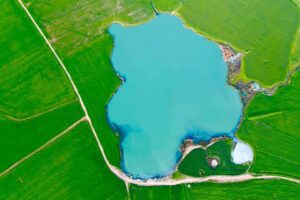
The (Ganaw) of Qurago is situated approximately 5 kilometers from the center of Rania and (70) meters north-west of the Lesser Zab River in the Sulaymaniyah Governorate, Kurdistan Region- Iraq.
The location of Ranya District, within the Sulaymaniyah Governorate of the Kurdistan Region of Iraq
Dimensions of the Pond.
In (2009) a team from the University of Sulaymaniyah conducted measurements of the pond. Their findings indicated that the pond has a diameter ranging from (350 to 370) meters and a depth of (24) meters.
Chemical and Physical Characteristics.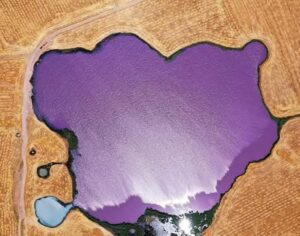
Qurago Ganaw possesses unique characteristics due to its concentration of dissolved chemical minerals, algae, and various bacteria, including sulfur, hydrogen sulfide, and various dissolved salts. These mineral compositions are responsible for the seasonal shifts in the water’s color, which notably transitions to purple—particularly during periods of drought and in the summer months.
The Color of The Qurego SpringWater changes According to TheSeason of The Year
Geological Formation.
Geological studies indicate that the site has existed since ancient geological epochs. The underlying rock strata consist of limestone formations from the (Kiewarash mountain) range or gypsum deposits, shaped by the distinct environmental conditions of various geological ages.
Water Quality and Characteristics.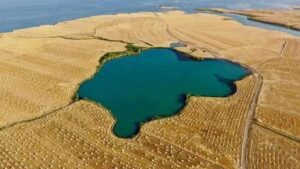
While pure water is typically colorless, odorless, and tasteless, the water of Qurago Ganaw is distinctively saline, alkaline, and bitter, making it unsuitable for human consumption. Until (2020), the water maintained a standard white appearance. However, due to drought and decreased precipitation, the chemical composition—combined with specific algae and bacterial activity—has shifted the color to purple.
A Habitat for Rare Biodiversity.
The pond serves as a habitat for various organisms, including worms, turtles, eels, small fish, and frogs. A unique type of plant known as (Karashia) grows along the banks. When this plant dehydrates, it combines with the pond’s sediment to create a new type of calcareous rock along the shoreline. Furthermore, collaborative research between the University of Sulaymaniyah and a German team has identified that the pond serves as a sanctuary for a rare species of turtle currently at risk of extinction globally.
Findings by Research Teams.
* Professor Dr. Diyar Ali (University of Sulaymaniyah): In (2006), Dr. Ali completed his doctoral research on this site, analyzing its chemical composition. In (2009), he collaborated with a team from the Iraqi Ministry of Environment to advocate for the site to be designated as a (Geopark) or a “Natural Reserve.
* German Archaeological Team (University of Munich): In (2015), under the guidance of Dr. (Simone Mühl), the team utilized drone technology to discover that the pond is composed of 24 smaller, interconnected pools.
* University of Sulaymaniyah Research. Scientific studies have confirmed that the species of algae and microorganisms found within the pond are rare and scientifically significant.
Health and Therapeutic Benefits.
Local residents utilize the water as a form of natural therapy, particularly for skin conditions such as irritation and inflammation. Annually, the site attracts numerous visitors for “therapeutic tourism.” As the author, I have personally experienced and verified these benefits. During the spring, the surrounding landscape, adorned with red anemones, offers a picturesque setting for tourists seeking leisure and photography.